Stay updated!
The best customer experience content delivered right to your inbox.
How Travel and Hospitality Brands Handle Seasonal Staffing Spikes Without Breaking the Contact Center


The six-question test for the best contact center platform for travel and hospitality CX
TL;DR
Travel and hospitality brands handle seasonal contact center spikes by making capacity elastic instead of fixed. The best contact center platform for this vertical absorbs routine surge with AI Virtual Agents, scales cloud capacity and seat counts with the season, blends digital and voice channels to flatten the queue, and uses conversational analytics to expose which contacts should never have happened.
Why this matters for travel and hospitality
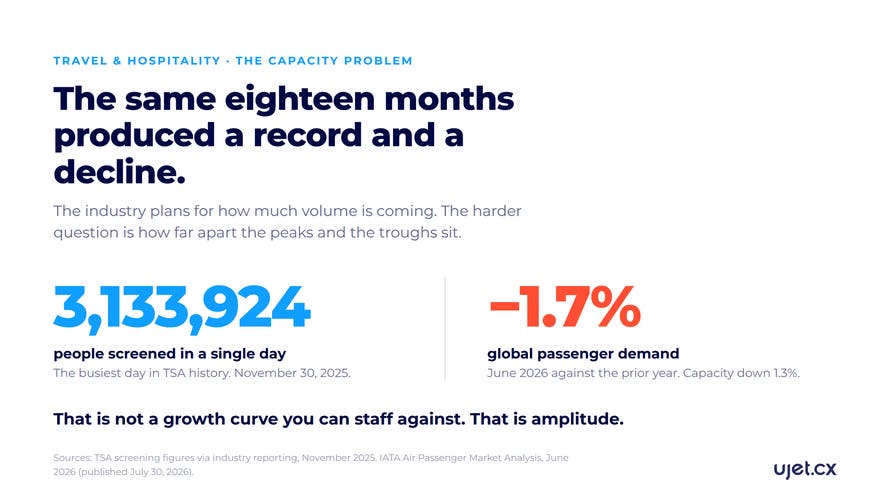
On November 30, 2025, American airports screened 3,133,924 people, the busiest day in TSA's history. Eight months later, IATA reported that global passenger demand had fallen 1.7% year over year.
Both facts are true. Both are the same problem.
The spike is not the problem. The swing is.
The industry keeps planning as if the question were how much volume is coming. It isn't. The question is how far apart the peaks and the troughs sit, and that gap has been widening for three straight years.
Look at the numbers together instead of separately. IATA projects 5.2 billion passengers in 2026, up 4.4% on 2025, after the industry closed 2025 with a record 83.6% full-year load factor. Eight of the ten busiest air travel days in TSA history happened in 2025 alone. And June 2026 demand fell 1.7% against the prior year, with capacity down 1.3%.
Record peaks and softening months, inside the same eighteen-month window. That is not a growth curve you can staff against.
Hospitality is living the same math from the other direction. In AHLA's Front Desk Feedback survey (246 hoteliers, conducted late February 2026), more than half of properties reported being somewhat or severely understaffed, and 42% named workforce shortages as a direct financial pressure. Seventy percent were offering higher wages to fix it. Fifty-four percent were offering flexible scheduling.
They are buying elasticity with payroll, because their operating model does not produce it any other way.
What a 100x swing does to a staffing plan
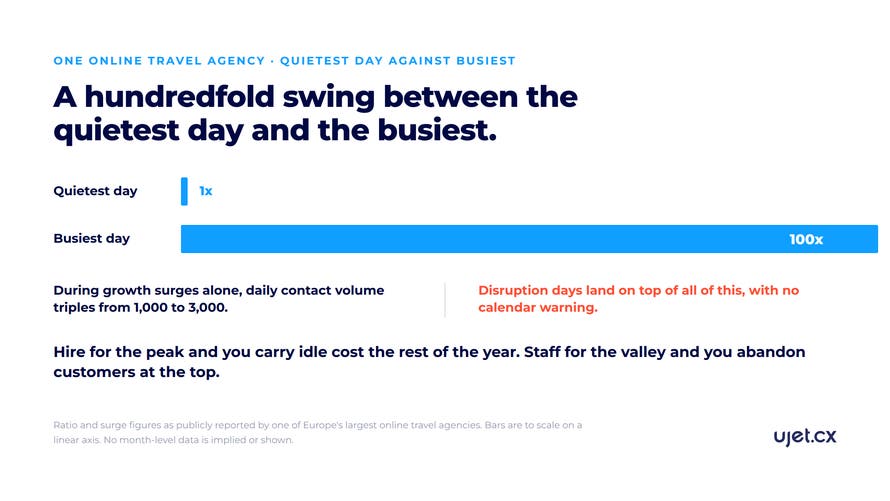
One of Europe's largest online travel agencies has publicly reported that demand between its quietest day and its busiest day scales one hundredfold, with daily contact volume tripling from 1,000 to 3,000 during growth surges.
No staffing model absorbs a 100x swing. Hire for the peak and you carry idle cost through every quiet stretch. Staff for the valley and you abandon customers at the top. Most travel brands split the difference and get the worst of both: overpaying through the quiet months for a team that is still underwater when the season lands.
Then there is the volatility nobody gets to schedule. In 2025, 58 million airline seats departing U.S. airports were hit by cancellations or delays exceeding two hours, according to Hopper Technology Solutions' Flexibility Imperative report (July 2026).
Some of that arrives in a single afternoon. On Saturday, November 8, 2025, FAA capacity cuts cancelled more than 1,500 flights and delayed roughly 6,500 across the U.S. system.
That is the distinction that breaks staffing plans. A seasonal peak you can see coming a year out. November 8 gave a few hours of notice, and it is also where loyalty gets decided: Hopper found that more than half of disrupted travelers received no proactive notification at all, and nearly half needed more than two hours to resolve their situation. Meanwhile 63% of travelers say they are more likely to book with a brand that offers a disruption assistance product. That tells you they are already paying for certainty. They will pay a competitor for it just as easily.
You can forecast the season. You cannot forecast the afternoon. You have to be built for both.
Why the headcount answer fails on its own math
The traditional response is surge hiring for peak season. It fails on arithmetic before it ever fails on quality.
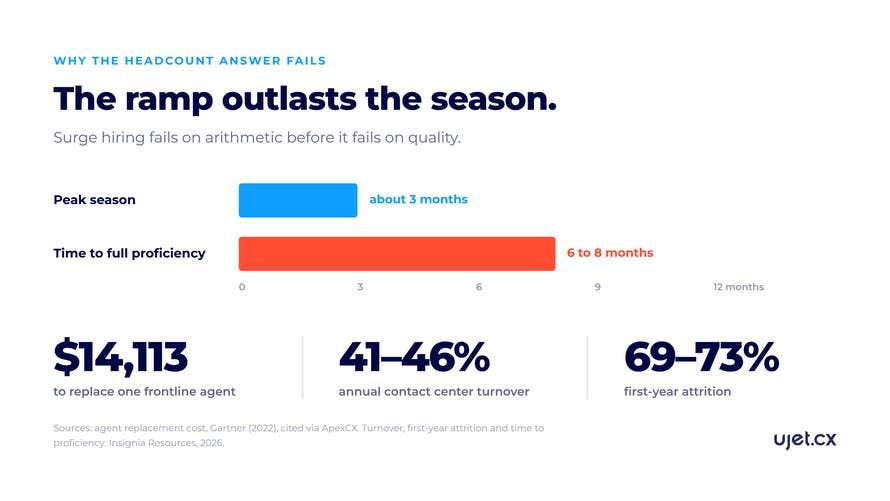
Gartner's 2022 analysis put the cost of replacing a single frontline agent at $14,113, and that figure excludes the productivity gap while the seat sits empty. Insignia Resources puts 2026 call center turnover at 41–46% annually with first-year attrition of 69–73%, and estimates new agents need six to eight months to reach the performance level of experienced staff.
Sit with that last number. An agent hired in September for the holiday peak reaches full proficiency somewhere around the time the season ends. You pay full price for partial productivity, precisely when the people on the other end of the line are the most stressed travelers of the year.
Customer patience closes the argument. In Nextiva's customer patience benchmark (n=400), 31% of customers said they would not wait past five minutes on hold, and 54% are gone within eight. A hold queue during a disruption cascade is not a service problem. It is a churn engine with a hold-music soundtrack.
What actually scales: the elastic contact center
Its time to stop scaling people linearly with volume and start scaling architecture. Four mechanisms, in the order they absorb a spike:
1. Virtual Agents take the routine surge. The majority of peak-season contacts are boringly predictable: booking changes, cancellations, refund status, check-in questions, directions, loyalty balances. An AI Virtual Agent handles them 24/7, resolving the request end to end rather than routing it into a queue with extra steps.
The word that matters is completion, not deflection. Deflection sends a traveler to an FAQ page. Completion changes the flight, processes the cancellation, confirms the rebook, with no human touching the interaction. A deflected contact is a delayed contact. A completed contact is a deleted one.
2. Elastic cloud capacity absorbs what fixed infrastructure cannot. UJET is built natively on Google Cloud, so platform capacity scales with the surge automatically: the concurrency that handles a normal Tuesday handles the day a storm grounds 400 flights, with no capacity-planning exercise in between. Seats flex too. A browser-based platform lets you add seasonal seats in days and release them when the trough returns, so the 100x swing becomes a seat count and an automation question rather than a hiring plan. And UJET's 99.999% availability SLA matters most on exactly the days volume triples: an hour of downtime inside a disruption cascade is revenue you do not get back.
3. Channel blending flattens the queue. Voice is the most expensive and least elastic channel you own, so the fastest way to survive a spike is to let travelers start in chat or SMS and escalate to voice only when they need it. SmartActions, UJET's in-conversation media and verification tools, lets a guest share a booking screenshot or a photo of a damaged room mid-conversation instead of reading a confirmation number over hold music. Every interaction that starts digital is a queue slot returned to the traveler who genuinely needs a human: the family stranded at the gate, not the one asking about checkout time.
4. Agents borrowed from anywhere. With a browser-based cloud platform, seasonal capacity stops meaning seasonal hiring. Back-office staff, remote agents, and BPO overflow can onboard onto an interface designed for fast ramp, with the CRM feeding them full guest history so proficiency is not a six-month climb. The ramp curve is a platform decision, not a talent problem.
The seasonal readiness test: six questions before peak season
Most platform evaluations in travel get run in the trough, when the pain is theoretical and everyone is agreeable. These are the six questions that predict what happens in the peak, and the answers to listen for.
| The question | What good looks like | Red flag | Why it matters in travel |
|---|---|---|---|
| 1. What happens to the platform when volume triples? | Cloud-native capacity that scales under surge automatically, and seats you can add or release as the season turns; no capacity-planning exercise standing between you and the spike. | Hard concurrency limits, pre-peak capacity requests, or performance that degrades exactly when volume spikes. Adding seats means a renegotiation. | Peak is when the platform earns its keep. Infrastructure sized to the average fails on the only days that decide loyalty. |
| 2. How fast is a new agent actually productive? | Browser-based, no desktop install, guest history surfaced in the agent view; seasonal, BPO, and back-office staff are live in days. | A six-to-eight-month proficiency curve, separate systems to learn, training that assumes a permanent hire. | Your peak season is shorter than a legacy ramp. If proficiency takes longer than the season, you never actually staffed it. |
| 3. What share of routine contacts never reaches a human? | Published containment and resolution numbers, broken out by contact type: changes, cancellations, refund status, check-in. | A single aggregate "deflection rate" quoted with no resolution measure. IVR menus counted as self-service. | A deflection that ends in a callback is a deferred contact, not an absorbed one, and it lands during the same peak, angrier. |
| 4. Can a traveler start in chat and finish in voice without repeating themselves? | Blended digital and voice on one platform, with conversation history, shared media, and CRM records surviving the escalation. | Separate stacks per channel. "Let me transfer you," followed by a request for the confirmation number they already typed. | A traveler who has to repeat their booking reference has already decided how the story ends, and who they'll tell it about. |
| 5. Can you see 100% of what happened last peak, before the next one arrives? | Every call, chat, and message analyzed automatically; contact drivers ranked; root causes surfaced with volume attached. | A 2–5% manual QA sample and a post-season CSAT survey as the only read on what went wrong. | You can only delete the contacts you can see. Next July is being written by a pattern nobody has read yet. |
| 6. Where do guest payment and passport details live? | CRM-first architecture: data is encrypted, transmitted to your system of record, and deleted from the platform after each session. Zero customer PII stored. | The contact center platform operating as a second system of record that grows with every seasonal spike. | Peak multiplies the sensitive data in flight. A second data store is a second breach surface, and it scales with your best month. |
How to actually run the evaluation
Timing decides the outcome more than the vendor list does.
Run it against last peak, not against a demo. Bring your worst week: the specific dates, the actual volumes, the contact drivers if you have them. Then ask each vendor to model it. A demo built on synthetic traffic tells you nothing about November 8.
Ask for containment by contact type, not in aggregate. "40% containment" means nothing if it is 90% on store hours and 5% on rebooking. Get the breakdown for the four contact types that actually spike: changes, cancellations, refund status, and disruption rebooking.
Price two scenarios, not one. Model your trough month and your peak month separately, then compare twelve-month totals against your current cost structure. That comparison exposes what peak-sized capacity really costs across a full year, and it is the number your CFO asks for first. The two-scenario view is the spine of the business case below.
Make them show the ramp. Ask how long a temporary agent takes to reach competence on their platform, then ask for a reference who has onboarded seasonal or BPO staff at volume. If nobody can produce one, the platform was built for permanent headcount.
Ask what they hand you when the season ends. The evaluation question is not what the platform does during the peak. It is whether next year's peak gets smaller because of what you learned from this one.
The part everyone skips: deleting contacts instead of answering them faster
Most seasonal volume is not demand. It is failure demand: repeat contacts, unclear cancellation policies, broken handoffs, and "where is my refund" loops that exist because nobody can see the pattern. And nobody can see the pattern because contact centers analyze only a sliver of their conversations. McKinsey puts manual QA coverage at less than 5% of total conversations; Puzzel's State of Contact Centres 2026 puts it at 2–5%.
During peak season, the unread majority is where your entire operational intelligence is buried.
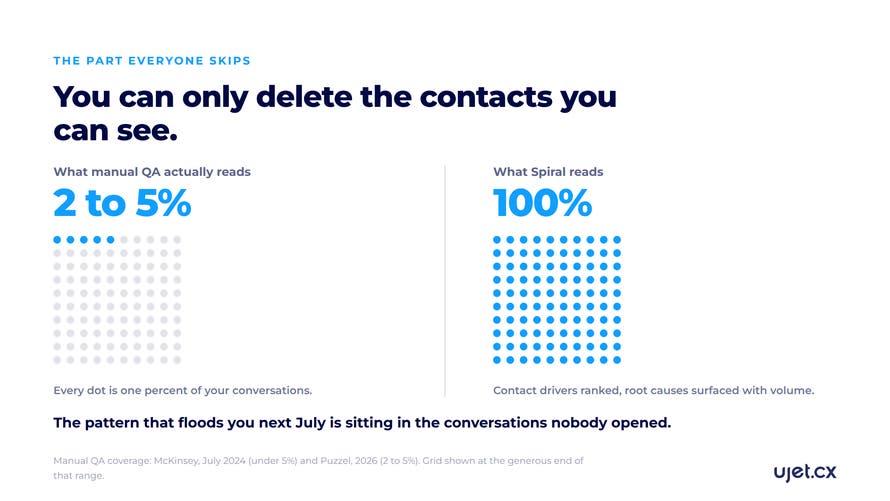
This is the job Spiral does. It analyzes 100% of calls, chats, and messages and tells you which contact drivers are spiking, which policy language is generating repeat calls, and which disruption response is failing, six weeks before the CSAT survey gets around to confirming it.
The economics are blunt. SQM Group links every 1% improvement in first-contact resolution to roughly 1% lower operating costs, and puts the industry FCR benchmark at 71%. At that benchmark, nearly three in ten of your peak-season contacts are people calling back about something that should have been resolved the first time.
The cheapest contact of the season is the one you deleted in the post-mortem of the last one.
UJET Virtual Agent is agentic AI in production today. AXO, Agentic Experience Orchestration, is generally available at the end of September 2026. It extends the same architecture: agentic AI orchestrating during the interaction, inside governed guardrails, so surge handling and governance stop being a trade-off in July.
What the evidence says this is worth
The honest version of the automation claim is narrower than the industry average, so here it is with the sources attached.
Turo, a UJET customer, deployed a virtual agent that deflects 25% of idle chats from the live agent queue, reduced average handle time by two minutes, and saved Turo agents seven days' worth of work time a month, as reported in 2022. Note what that measures: idle chats, not total traffic. It is a real number about a specific slice, which is exactly the kind of number the third question in the test above is designed to extract from a vendor.
For the wider market signal: on a different technology stack entirely, one of Europe's largest online travel agencies has reported containing 50% of all customer-service traffic through its virtual agent, with average chat durations under 50 seconds. That is not a UJET deployment and we are not claiming it. It is evidence that half of travel's contact volume is genuinely automatable, which is the premise the entire elastic model rests on.
On the platform itself: UJET has been a G2 Leader for 25 consecutive quarters, with 98% of reviewers rating the platform 4 or 5 stars and 93% saying they would recommend it.
The business case finance will actually approve
Operations runs the evaluation. Finance approves it. The gap between those two conversations is where platform decisions stall, usually by a quarter and sometimes by a peak season.
The instinct is to pitch elastic architecture as a labor-reduction play. Labor is in there, but it is not the frame that moves a CFO in a vertical this volatile. The frame that works is cost certainty across the full demand curve, which means putting four cost categories in one model instead of four separate reports.
| Cost category | What it is today | What elastic architecture changes |
|---|---|---|
| Idle capacity | Seats, licenses, and supervision paid for through the trough | Fast seat flex sizes the core team to the trough, not the peak; elastic capacity and automation cover the gap when demand returns |
| Seasonal ramp | Recruiting, training, and early-tenure productivity loss that outlasts the season | Fast onboarding plus Virtual Agent absorption shrinks how many seasonal seats you need at all |
| Overflow | Per-contact BPO cost when the surge outruns the core team | Automation takes the first layer of the spike before overflow ever activates |
| Avoidable contacts | Volume that completion-grade self-service should have deleted, plus the failure demand nobody has diagnosed | Virtual Agent completes the routine; Spiral finds the contacts that should never have happened |
The compounding is the argument. A platform that trims overflow while also deleting a category of avoidable contacts produces savings a single-line labor number cannot capture, and it produces them in the same quarter the CFO is being asked to sign.
There is a second argument finance understands but rarely sees made explicitly: peak-readiness is risk reduction, not just operating leverage. A queue collapse during a disruption event is not a service incident; it is a revenue event. Travelers who cannot rebook, rebook with a competitor. Guests who cannot reach support escalate to chargebacks. The cost of a bad peak week is not the overtime and the overflow invoices. It is the bookings that walked while the queue was collapsing.
What finance ultimately needs is a model that answers three questions: which contacts disappear through self-service completion and what each one fully costs today, which contacts shift to cheaper channels and what the delta is, and which contacts still need a human, and what the right staffing model is for that residual volume. The contact center ROI calculator builds the first version of that model in about thirty seconds, from your actual contact mix, staffing structure, and seasonal profile rather than industry averages.
The shortlist standard
Elastic architecture is the right answer for a specific shape of company. It is worth being honest about which.
This is the right call if:
- Your contact volume between trough and peak varies by more than 3x, or disruption events regularly triple your daily queue.
- You are hiring seasonal, temporary, or BPO agents and losing weeks to ramp time.
- Salesforce, ServiceNow, or a modern CRM is already your system of record for guest data.
- You are paying for peak-sized license capacity year-round.
- You have never seen a ranked list of what actually drove last season's volume.
This is the wrong call if:
- You need the contact center platform itself to be your system of record for guest data.
- Your volume is genuinely flat year-round and fixed licensing is already efficient.
- You want maximum AI autonomy with minimal oversight. Controllable AI is the entire point of this architecture, and control has a cost.
Travel brands sizing up their next peak can run the numbers or talk to our team.
FAQ
How do travel brands handle seasonal contact center staffing spikes?
By making capacity elastic instead of hiring linearly. AI Virtual Agents absorb routine surge volume 24/7. Cloud-native infrastructure scales platform capacity with the surge automatically, and browser-based onboarding lets seat counts flex with the season instead of staffing to the peak year-round. Digital channels blend with voice to flatten the queue. And conversational analytics identify and eliminate failure demand between seasons. Surge hiring fails on math: Gartner put the cost of replacing an agent at $14,113 in 2022, and new agents need six to eight months to reach experienced-staff performance, longer than the season they were hired for.
What share of travel contact center volume can a Virtual Agent handle?
It depends entirely on contact mix, and you should be suspicious of any vendor who answers with a single number. In UJET's published travel deployment, Turo's virtual agent deflects 25% of idle chats from the live agent queue and saved seven days' worth of agent work time a month. Separately, on a different platform, one of Europe's largest online travel agencies has reported containing 50% of total customer-service traffic. Brands with high booking-change and refund-status volume sit toward the top of that range; brands whose volume is dominated by complex disruption rebooking sit lower.
How do you protect service quality during a flight disruption event?
With proactive capacity rather than reactive heroics: 24/7 Virtual Agent coverage for rebooking and status questions, channel blending that moves travelers off hold queues into asynchronous messaging, routing that prioritizes stranded travelers over routine inquiries, and real-time visibility into which contact drivers are spiking. The stakes are commercial. In 2025, more than half of disrupted travelers received no proactive notification at all, and 63% of travelers say they are more likely to book with a brand that offers a disruption assistance product.
What is failure demand in a contact center?
Contacts that exist only because something upstream failed: repeat calls after an unresolved issue, confusion created by unclear policy language, status-check loops, handoffs that dropped context. At the industry's 71% first-contact-resolution benchmark, close to 30% of volume is callbacks. Conversational analytics covering 100% of interactions, like Spiral, surface those drivers so they can be eliminated before next season rather than answered faster during it.
Why does CRM-first architecture matter for travel and hospitality brands?
Travel interactions are dense with payment data, passport details, and personal itineraries, and peak season multiplies the volume of it in flight. UJET's CRM-first model keeps that data in the brand's system of record: customer communications are encrypted, transmitted to the CRM, and deleted from UJET's platform after each session, with zero customer PII stored. Guests get context-rich, personalized service, and the brand avoids maintaining a second data store that grows with every seasonal spike.
Is it cheaper to hire seasonal agents or automate the surge?
Automation wins on both cost and speed. Seasonal hiring carries recruitment cost, a replacement cost of roughly $14,113 per agent, and a six-to-eight-month proficiency curve that outlasts most peak seasons. Automation absorbs routine volume from day one without adding a single seat. The honest framing is that it is not either/or: automation handles the predictable surge so human capacity is reserved for the interactions where a person actually changes the outcome.
How do you build the business case for an elastic contact center?
Put four cost categories in one model: idle capacity paid through the trough, seasonal ramp cost, BPO overflow cost at peak, and avoidable contacts that completion-grade self-service should have deleted. Frame the total as cost certainty across a volatile demand curve rather than labor reduction, and add peak-readiness as risk reduction. A queue collapse during a disruption event costs bookings and chargebacks, not just overtime. Finance approves fastest when the model shows which contacts disappear, which shift channels, and which still need a human, each with its fully loaded cost.
When is UJET's agentic AI generally available?
UJET Virtual Agent is agentic AI in production today. AXO, Agentic Experience Orchestration, is generally available at the end of September 2026. AXO extends the same CRM-first architecture into in-interaction orchestration, with governance guardrails applied while the conversation is happening rather than reviewed afterward.
The best customer experience content delivered right to your inbox.
About the authors